|
|
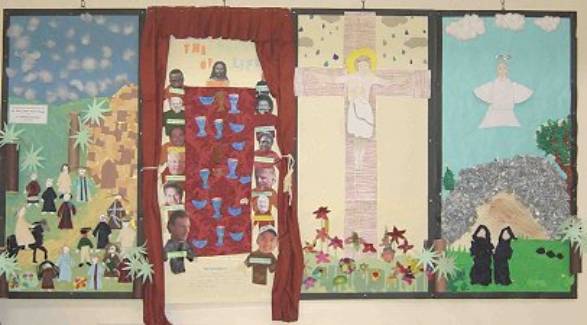
'Have you been into St. Giles' Church Hall recently?
On display is a mural depicting the Easter story. It was created by the
St. Giles' Junior Church groups and the 2nd Ickenham Brownies. The
Climbers and Scramblers (aged 3 to 7) enjoyed making a collage showing Jesus
entering Jerusalem. The Pathfinders (aged 11 to 14) met the challenge by
showing what a modern Last
Supper might be like, The Explorers (aged 7 to 11) created a superb scene
showing the Crucifixion and the Brownies' carefully made contribution shows the
Resurrection. Finally we added some palm trees made by the Jack and Jill
toddlers (and their carers).
Ann Brand
CHRISTIAN GEOMETRY
One of my favourite books was written in 1884 by 'A. Square', describing the life of a community of geometrical figures - triangles, squares, etc.- who live in 'Flatland' - or on a large piece of paper.
Because they live in only two dimensions there is no way that they can see different shapes - their field of vision is like looking out through a very narrow letter-box - and so they have to rely for recognition on feeling each others' outlines.
æ
As a result, a whole social structure has grown up based on the size of one's sharpest corner, which is also a measure of one's intelligence. At the bottom of society are the soldiers - very thin isosceles triangles, who are both stupid and dangerous. At the other end of society are the priests - multi-sided polygons who are both wise and harmless. (They like to pretend to be the 'ideal' figure of a circle, but those who know them personally say that if you get close enough you can definitely feel their corners!)
æ
The narrator of the story, a middle-class square, one day hears a voice saying to him "Come up". The word' up' has no meaning in Flatland, of course, and after trying forwards, backwards and sideways he has to ask his mysterious visitor to explain what he means. The stranger then says he will demonstrate, by passing up and down through Flatland, and appears, first as a point, which becomes an ever growing, and then shrinking, circle until disappearing again. The visitor thus reveals himself as a sphere - a three-dimensional being, visible in Flatland only in cross-section as a circle.
æ
The sphere then lifts the square right out of his plane, and shows him from above the whole of Flatland, so that for the first time he can see what his two-dimensional world and its inhabitants are really like.
æ
He then takes him to visit the land of one dimension: a straight line with a number of individual segments along it - like tube trains in a tunnel. When they try to speak to one of these, it immediately assumes it has been addressed by either one neighbour or the other (the limits of its known world) and furious arguments break out. A visit to a land of no dimensions - a single, self-sufficient point - is even more frustrating, since when they speak to it, it only says "What on earth put that into my head?"
The square then says to the sphere "You have shown me the limitations of life in two, one and no dimensions, and all the freedom you enjoy in three - now please take me to a land of four dimensions." To which the sphere replies "Don't be ridiculous - how could there possibly be more than three?".
æ
The book ends on this punch line, and was written only to make a mathematical point, but it is not difficult to read it as a parable of the incarnation.
æ
1. It is futile for us, who live in time and space (four dimensions) to try to comprehend God, who lives 'beyond' time and space.
2. The only way we can have any idea of Him is if he can show us a cross-section of Himself in time and space - and this is precisely what he did in Jesus.
3. Just as the (perfect) circle was the best possible two-dimensional representation of the sphere, so is Jesus the best possible representation, in time and space, of God.
4. Our mental picture of God should, therefore, not be of a remote patriarchal figure, but rather of a vigorous young man with a sense of humour, who enjoys parties - and who insists on washing his friends' feet.
John Fowling
|
|
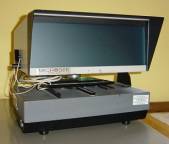
The February edition of ICN carried a short article of thanks for the gift, to St. Giles‰ Church of Microfiche records of its births, deaths and marriages. An appeal for a Fiche reader was also published.
Through the good offices of Tom Morgan of The Grove, Ickenham, the Hillingdon Family History Society has now given St. Giles' Church a second hand "Micro-See 270-EX" microfiche reader.
Should readers wish to take advantage of these resources
contact verger, John Ralph, on 01895 673006 to make an appointment.
LETTER TO THE EDITOR
Dear Editor: As someone who has spent
80 years as a bookseller, it grieves me to read of the demise of Hayes Bookshop
in the Village. There is something special in dealing with books, and although
I did not know the Glover family personally, I feel they would have encountered
many famous people over the years, as I did.
In my own bookshop, near the British Museum
in Great Russell Street, there were many famous people who visited. They
included Winston Churchill, David Attenborough, Cardinal Gasquet (Abbot of
Downside Abbey), Lord Robbins (on whose farm Heathrow Airport was built),
Anthony Eden, Wallace Budge, and Lord Carnarvon (of Tutankhamen fame), Michael
Foot, John Burns etceteras.
John Betjeman used our shop in his BBC
documentary ‹Summoned By BellsŠ, and on one occasion I mentioned that I lived
in Ickenham. He remarked ‹á.a pretty little village somewhat spoiled by a row
of modern shops in the Swakeleys RoadŠ. I wonder what his description of our
village would be if he came back today and walked up the High Road, which was a
lovely tree-lined avenue, but now is lined with cars, and where the main oasis,
our friendly garden centre with its display of plants and flowers, has been
taken over by developers?
Sincerely
Stanley Wheeler š High Road, Ickenham