

 æBRIAN‰S
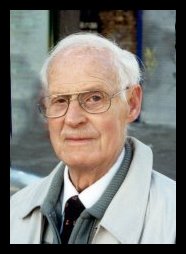
æ BRIAN THEODORE DAVIES 1915-2002
Readers will be saddened to hear that Brian passed away, peacefully, in Hillingdon Hospital on 17th December 2002 after a period of months during which his health had been deteriorating. Brian will be missed, greatly, by all who knew him and our thoughts, and prayers, are extended to his wife Eileen, both children, the three grandchildren, all his friends and other members of the family.
Brian was born in Yorkshire in
1915 when his parents moved to the region from their home in the South-East. He
was born into a family ofæ ëBrethren‰
and had always enjoyed writing on matters Christian.
æ
He got a scholarship to Tadcaster
Grammar School but moved to Leeds shortly afterwards. At the tender age of
fourteen years he declared the Christian faith that became his guide, and
motivation, for life.
His adult working life was spent
in the Engineering Industry until retirement some years ago.
Brian had a talent for writing
and used it to bring the word of God to people all over the world. He was still
writing throughout his illness.
Brian had been published in many
different magazines in this country, including our own Ickenham Church News, as
well as in New Zealand, U.S.A, Canada and in the Caribbean.
His own Web pages will continue
to be published here and will be updated from time to time from the wealth of
articles he had sent to the editor.
He moved to London in 1949 and
married Eileen, from Northumberland in 1962. They set up home in Hillingdon and
in 1969 moved into Ickenham. He leaves Eileen, his two children and three
grandchildren.
Brian will be missed greatly. I
miss him.
Editor
The views expressed in the following articles are those of Brian T Davies and are not necessarily those of the Church of England or The United Reformed Church.
A REMARKABLE LADY
We have seen in
recent months the passing of a remarkable lady. Yes,
whatever her title, she was a lady!
The 20th century saw an increase in the number of women in prominent national positions, but the three outstanding ones, here in Britain, have been the Queen, the Queen Mother, and, whether we like her or not, the ennobled Margaret Thatcher, the first woman to become British Prime Minister.
The Bible centres
mostly round men's activities, and thinking of the Old Testament with its long
history there are relatively few women mentioned, so it may be difficult to
choose the most outstanding of them with so little detail to go on.
However, overall I
think that Abraham's wife Sarah, which means princess, is
the candidate to top the list. She, and Abraham, lived to a ripe old age,
waiting around as long as perhaps sixty years to have their first, and only,
child Isaac.æ When she died, at the age
of one hundred and twenty-seven years, it was a time of great mourning for both
Abraham and Isaac. There is no other instance cited of such clear expressions
of grief. This even includes Jacob when his beloved Rachel died giving birth to
twins.
Isaac was so
attached to his mother he never seems to have looked at another woman.
Unusually he was still unmarried at the age of thirty seven when she died.
Significantly, when Abraham's servant was sent to find a wife for Isaac the criterion he set was to search for a woman who would show a practical, caring, spirit. After three years of sorrowing it is said he was at last comforted by Rebekah's arrival. Surely it speaks volumes for the quality of Sarah as truly a gracious women living up to her special name.
Abraham was said to have been a friend of God because of his faith - faith in His promises.æ Whilst Sarah's faith, at least in one instance, does not seem as solid as his, she is cited among the list in Hebrews of those commended for having faith.
Faith in God was what marked them out, and there is no doubt that sharing such a faith is a binding and rewarding experience which adds to the quality of people's lives.æ Endurance is the key to their long life together.æ How many will share in this experience today when they without thought of God, or the morrow?
THE SAW
The saw is one of the most ingenious, and
simplest, of tools man has created.
We know from archaeological finds that they
were used over 4,000 years ago by the Egyptians, and the Assyrians, and there
is a possibility they could even have been used by Noah in shaping the wood for
the Ark.
By adapting their design, saws can be made
to cut not only wood but iron and stone.
Saws were used to help shape the huge stone
blocks needed in the construction of Solomon's temple.
Today, these blocks would be cut in a
similar manner, but more easily and precisely, with the aid of power tools.
Once it was found that it was easier to cut
wood using a toothed blade, it needed considerable experimentation to work out
how the idea could be developed to cut through harder materials such as stone and metal.
Despite this, the principle remained the
same. Each tooth removed a little piece of material at a time. Considerable
amounts were cut from soft materials using a few large teeth, whilst in the case
of harder substances, lesser quantities were removed with more, and finer,
teeth. It is easy to test the difference by
attempting to cut wood with a hacksaw.æ
There is a lesson in this for us. It
follows the old adage ‹many hands make light workŠ. For example, sharing the
burden of life and building up teamwork. The more we work together the more is achieved. Sometimes, together,
we can do the seemingly impossible.
Each of us can be a 'tooth', for every
little helps especially when, like a saw, the effort is applied over
and over again.
Paul spoke of his fellow workmen in an
appreciative manner because, however small was their offering, they helped him
on a regular basis with his work.
Initially it was the closest
disciples of the Lord who took the Christian faith to the world,
but eventually it was the combined efforts of many hundreds of believers
that led to Constantine‰s Rome acknowledging the value of Christianity to
the State. It may not have been the kind of constitution which we would have
chosen, but it does show us how change can be wrought through the efforts of
the faithful.
It was as if saws had been used to cut
through the ëblock‰ of pagan beliefs which had marked the Roman empire.
Slowly, and little by little, where people
join together in mutual co-operation, much can be achieved.
æ
By the constant dripping of a
water-dropæ a channel is made. Then a
pool is formed, and finally it becomes a pond.
We may not be able to do great things on
our own, but we must not underestimate the contribution we can each make by
persistent and constant support of each other. ‹Pounds are made by collecting
penniesŠ is an almostæ forgotten
maxim.
Whenever you pick up a saw just note the teeth on the blade to see if they suit the material you are going to cut, and consider the contribution each tooth makes towards its goal.
æ
Remember too, each and every little kindness rendered contributes to the building of a better world.
The frog he would
a-wooing go,
Slippery and slimy
with bulging eyes,
A little bird
said, "What chance have you
Of finding a mate
who will love you true?"
"Ah
now", said the frog, ''as I've got older
I've learnt that
beauty's in the eye of the beholder.
The one who will
take me will be the best;
The most bulging,
the slipperiest and the slimiest".
‹Everyone
to their tasteŠ, we say; but there are things which we can all accept as
beautiful, or ugly. It would be a poor soul who could not say, at some time,
what a wonderful world we live in.æ
‹When
I behold the work of Thy handsŠ were the words of the Psalmist as he
marvelled at God's handiwork, but he found even more to marvel at in God‰s
nature.
æ
The
thought of God's moral perfection, and intrinsic purity, transcending anything
found in us required a new word that would describe it and allow us to sing of
its beauty. That word was holiness.
What
can God possibly see in man, whose thoughts and ways do not correspond with
His?
We
should ponder whether we have advanced at all in our beliefs compared with people‰s
faith in God thousands of years ago.
We
boast of our modern technological achievements but our society‰s spiritual
decline has lost to us any realistic conception of God and His requirements. We
compare very poorly with those earlier people.
Jesus
Christ came to show us the beauty of moral purity. He came to bring not only
hope, but the way of transforming us into His likeness and to indicate that we
can establish a loving relationship with Him.
The
Christian shares in that beauty and in the promise of being in His presence
when this life ends. Should not this be the desire of us all?