

23RD APRIL
St. George
Patron Saint Of England
The life of Saint George is shrouded in legend, so much so that it is quite difficult to untangle fact from fiction. Much of the problem lies in the Acta Sancti Georgii (Acts of Saint George) written at a very early date and outlawed by Pope Gelasius in AD 496. Meanwhile the Greeks also had a set of Acts which were more accurate and quoted by Saint Andrew of Crete.
 |
From them and the writings of Metaphrastes, we can piece together that he was born in Cappadocia of noble, Christian parents and on the death of his father, accompanied his mother to Palestine, her country of origin, where she had land and George was to run the estate. He was martyred at Lydda in Palestine (Nicomedia). He held an important post in the Roman army - the rank of tribune, or perhaps colonel in modern terms - during the reign of the Emperor Dioclesian (245-313). Dioclesian was a great persecutor of Christians (from about 302) and when the persecutions began George put aside his office and complained personally to the Emperor of the harshness of his decrees and the dreadful purges of Christians. For his trouble, though, he was thrown into prison and tortured. |
He would not recant his faith however and the following day he was dragged through the streets and beheaded. It is uncertain whether he also tore down the Emperor's decrees as they were posted in Nicomedia. So he was one of the first to perish. The Emperor's wife, Alexandria was so impressed at the Saint's courage that she became a Christian and so too was put to death for her trouble.
The origin of the legend, which is very well known, came originally from the way in which the Greek Church honoured George. They venerated him as a soldier saint and told many stories of his bravery and protection in battle. The western Christians, joining with the Byzantine Christians in the Crusades, elaborated and misinterpreted the Greek traditions and devised their own version. The story we know today of Saint George and the dragon dates from the troubadours of the 14th century.
The reason for his being adopted as the Saint of Battles was partly because he was a soldier, but also because he is said to have appeared to the Christian army before the Battle of Antioch. It is also said that he appeared to our English King Richard I (the Lionheart) during his Crusade against the Saracens, which served as a great encouragement to the troops.
The cult of Saint George goes back a long way - certainly to the 4th century. The Syrian Church held him in great esteem. The church of Saint George In Velabro - (The Veil of Gold) - Rome, dating from about that time was built. Saint Clothilde, in Gaul dedicated a church to him; in Venice, he is the second patron after Saint Mark; the Greeks hold him in honour. And in 1222 the Council of Oxford appointed 23rd April as his Feast Day. He became the English Patron Saint in 14th Century and he became associated with the Order of the Garter. He is also the patron saint of Moscow in Russia, and was, until 18th century, patron of Portugal (when they broke from Spain in 12th century, they had to choose a new patron: their acquaintance with the English in the Crusades confirmed George as the natural successor - he remains still "in charge" of the army), and of Aragon. St George is also the Patron Saint of the Scouting Movement
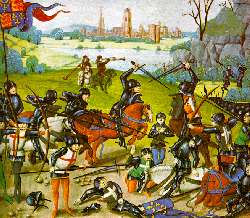
The Seige of Harfleur 1415
" I see you Stand like greyhounds in the slips,
Straining upon the Start. The game's afoot:
Follow your spirit; and, upon this charge
Cry "God for Harry! England and Saint George!"Shakespeare, Henry V (1599) act 3, sc. 1, l. 31
SAME STORY
PLUS
ADDITIONAL DETAILS ABOUT ST. GEORGE
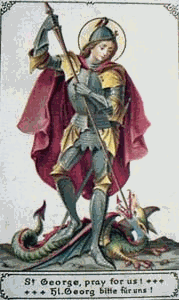 |
The life of St George is shrouded in legend, with many tales
of his bravery and martyrdom having been told over the years. George was born in about 280 AD in Cappadocia, Asia Minor (now known as Turkey) of noble and wealthy Christian parents and it is thought that he was of tall stature with fair hair. When his father died he moved with his mother to Palestine and followed the usual path of most young noblemen by joining the Roman Army at the age of 17. Very quickly his ability and charm, coupled with his virtue and chivalry, earned him quick promotion to the rank of tribune (similar to that of a Colonel) in the Imperial Guard of Emperor Diocletian. |
During his time in the army he is believed to have travelled to Britain, visiting
such holy places as Glastonbury and Caerleon. It is thought that he was accompanied
by Constantine, a fellow officer and friend who later became the first Christian
Emperor of Rome.
It was during his time in the army, when he was stationed near Silene in Libya,
that the most famous of the legends was born - that of his fight with the dragon,
which was documented by James de Voraigne, a bishop of Genoa.
According to the legend a large beast, described as a huge crocodile with scaled
wings, lived in a lake and terrorised the nearby town. Whole armies had tried
to kill the dragon but had been defeated. The dragon had taken up a position
outside the town gates which meant that nobody could get in or out of the town
and it‰s breath was said to be so poisonous that people would drop dead in the
nearby area. Therefore, in order to try and keep the dragon away from the city
walls the locals offered it two sheep a day. However, they soon ran out of sheep
and decided to try sacrificing some of the citizens, starting with the young
maidens. Finally the King‰s daughter was selected for sacrifice and was put
outside the city walls to await her fate. At that point George came along, mounted
on his white horse, and slaughtered the dragon with a single blow of his lance
thus rescuing the princess. For such a deed he was given a large reward by the
king which he distributed to the poor before riding off back to the army.
George returned to Nicomedia to find that Emperor Diocletian, who was a pagan,
was persecuting all Christians and putting them to death. Things came to a head
on 23 February 303 when Diocletian issued a formal edict against Christians
decreeing that ëAll churches should be levelled to the ground. All sacred books
should be burned. All Christians who hold any honourable rank should not only
be degraded but should be deprived of civil rights. All Christians who are not
officials should be reduced to slavery‰. This enraged George so much that he
tore down the edict and threw it away, which resulted in him being arrested
and brought in front of Diocletian.
In the subsequent confrontation George denounced the Emperor for the harshness
of his decree and the dreadful persecution of Christians. Despite a number of
inducements, George refused to renounce his faith and therefore was thrown into
prison and tortured before being dragged through the streets and beheaded on
23 April 303.
He was buried in his mother‰s home by the sea at Lydda, Palestine although his
head was taken to Rome, where it was preserved in the church that was dedicated
to him. When Constantine became Emperor in 306 he ordered that a church be built
over the grave of St George which became a shrine for all Christians.
Before long, the stories of his courage spread and he became famous all over
world. A number of churches were dedicated to him š over 200 in Egypt alone.
In 1222, the Council of Oxford appointed 23 April as his feast day and in 1415
he became the patron saint of England following the Battle of Agincourt. In
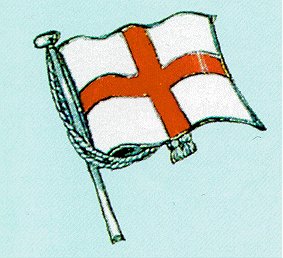
1497 in the reign of Henry VIII, the pennant of the Cross of St. George was
flown by John Cabot when he sailed to Newfoundland and it was also flown by
Sir Francis Drake and Sir Walter Raleigh. In 1620 it was the flag that was flown
by the Mayflower when the Pilgrim Fathers arrived in Plymouth Massachusetts.
It is also the flag of the Church of England and as such is known throughout
Christendom. He is also the patron saint of Catalonia, Moscow, Georgia and Aragon
as well as being the Saint of Battles.
Saint George is our Patron Saint, a Dragon Slayer and man who`s life deeds were deemed to be such, that a higher force, that which only God himself could have ordained...
Saint George was Patron Saint of England in the days of King Arthur and the Knights of the Round Table. His lore of valour against adversity, and protection of the Christians in a determined stand against tyranny and repression sat well with the ideal of the Crusades, Jehad and Holy Wars that would come to pass...
The Liberation of the Holy Lands was a priority to the Realm in the days of the Crusades and England's spin-doctors adopted the icon of Saint George, Dragon Slayer, Liberator of the Oppressed and gave him a National Flag, that is, the Red Cross and a song, Onward Christian Soldiers...
He was to become the Patron Saint of all England, with a philosophy that guides us, America and the United Nations to this day...
Although it is in English folklore that Saint George slew the mighty dragon in England to which end, two places are named, that of Dragon Hill near Uffington, Oxfordshire, and Lower Stanks, a field outside Hereford...
But, in reality, it is thought that St. George came from Cappadocia in Asia Minor, lived at the time of the Roman Emperor, Diocletian, AD 245 to 313 and never actually graced our fair Isle. He became a high ranking cavalry officer in the Army of Rome but refused to carry out Diocletian's orders for Christian persecution and, in consequence, suffered torture and maybe death himself.
He was canonized in AD 494, Pope Gelasius proclaiming him one of those "whose names are justly revered among men but whose acts are known only to God".
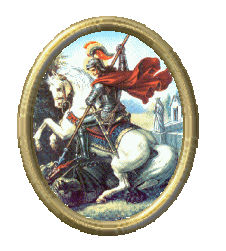
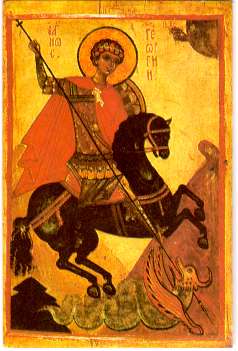
The legend of St. George, which is an allegory illustrating the triumph of good over evil, tells how he rode into the city of Silene in what is now Libya, to find the people terrorized by a dragon which was fed daily with one of the citizens. The next victim was to be Cleolinda, daughter of the King, but St. George rode out, slew the dragon and freed the people from their oppressor.
Thus, whether in the context of history or legend, to Baden-Powell, St. George epitomized the qualities of selflessness and both moral and physical courage
"And the great dragon was cast down, the old
serpent, he that is called the Devil and Satan, the
deceiver of the whole world; he was cast down to
the earth, and his angels were cast down with him.
And I heard a great voice in heaven, saying, Now
is come the Salvation, and the power and the
kingdom of our God and the authority of his
Christ."
Revelation 12:9-10
The story of Saint George and the Dragon was included in Jacobus de Voragine's collection of Saints' lives written about 1275, to become part of the Golden Legends, translated into English and published by Caxton in 1483. A modern version says:
"At the town of Silene, in Libya,
there was a dragon, who was appeased
by being fed two sheep a day; when
these failed, the townsfolk offered by lot
one of their young people. One day the
lot fell on the King's daughter, who
was led out to the sacrifice, dressed in
her wedding gown. George appeared
and transfixed the dragon with his
spear and then using the Princess's
girdle led the bemused dragon into the
town, where it was beheaded."
Link to all Aspects of St. George