

Although it may not be necessary, some people think it desirable to know something of the life of the saint to whom their parish church is dedicated. The story of our own St. Giles is quite a simple one, and was brought about by the young man's conscience.
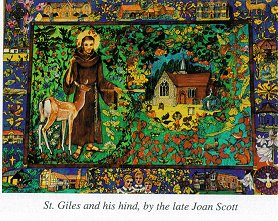 In the early part of the 7th century A.D., there lived in Athens a Greek family, greatly respected by all who knew them. The head of the family was a wealthy man who had great influence in high places. While journeying into the beautiful countryside surrounding his home, purely for pleasure, Giles, the son of the house saw the plight of the lepers, the lame and the beggars, and there were many of them. Living a life of consummate ease without the slightest effort on his part, the young man became uneasy in his mind.
After giving the matter some thought, he left his comfortable home, taking nothing with him, to drift aimlessly, seeking food and shelter wherever it was to be found. His wanderings took him into France, where he lived a monastic kind of life at Arles for a time. Not satisfied, he travelled on to Nimes, where he found a cave to live in among the Garrigue Hills. He was a kindly man and offered help and spiritual guidance to all who sought it. His kindness extended to animals as well as his fellow creatures. He so befriended a young doe, that it became tame enough to allow him to milk her and so solve one of his food problems. It seldom strayed far from the hermit's home in the cave, where the entrance was shielded by a dense thicket of thorn bushes.
 One day a Gothic king was out hunting with his courtiers, when some of his dogs gave chase to the young doe. She easily outpaced them, and disappeared in the thicket which guarded the hermit's cave. A few days later the same thing happened again. This rather intrigued the king, so that he hunted in that part of the hills again. When the elusive doe had evaded them for the third time, the hunters gathered before the thicket. It seemed to them to be almost impenetrable. One of them shot an arrow into the bushes. They heard a noise which sounded like a gasp of pain. Forcing a way through the bushes at the least dense part, they came upon the deer at the feet of Giles, who was sitting in his cave, wounded by the arrow.
The king was overwhelmed with sadness at the turn of events. He offered gifts of money as compensation, but these were firmly refused. Giles did accept the offer of the help a physician would be able to give, which the king had promised him.
Thereafter the king visited Giles on many occasions and frequently offered him gifts of money. These were always civilly but firmly refused. One day after giving the king's offers of money much thought, Giles suggested to the king that he should devote the money he had offered so many times, to the building of a monastery. The king readily agreed to this, but in his turn suggested that Giles should become the first abbot. This too, was agreed upon, and it came about that the monastery was built, and Giles did become its first abbot.
The commemoration day of St. Giles is the First of September. He is the Patron Saint of beggars, cripples and lepers. The sign of the Saint is a doe and an arrow.
During the restoration of the Ickenham Parish Church in the years 1921 and 22, the more flamboyant gilded cock was taken from the stables at Swakeleys, to replace the insignificant, but much more appropriate arrow of St. Giles on the weathervane of the Church of St. Giles.