|
FROM ST GILES’ CLERGY
 I am not a political animal, so I was surprised to find myself logging on to the government web site to register my objections to pay-as-you-drive tolls, a system whereby your journeys may be monitored by satellite and you are charged different amounts according to the roads you drive on and what time of day you use them. The bureaucracy that such a scheme would require to make it work boggles the mind. You would need people to monitor on computers the millions of journeys made each day, still more people to send out the bills and receive payments, and an army of people to answer all the queries from motorists who think they have been incorrectly charged, another army of people to chase up those who fail to pay etc., etc. I am not a political animal, so I was surprised to find myself logging on to the government web site to register my objections to pay-as-you-drive tolls, a system whereby your journeys may be monitored by satellite and you are charged different amounts according to the roads you drive on and what time of day you use them. The bureaucracy that such a scheme would require to make it work boggles the mind. You would need people to monitor on computers the millions of journeys made each day, still more people to send out the bills and receive payments, and an army of people to answer all the queries from motorists who think they have been incorrectly charged, another army of people to chase up those who fail to pay etc., etc.
If such a scheme ever comes into operation, then without doubt makers of satellite navigation systems for cars would add another button so that you can choose not the quickest, nor the most scenic route, but the cheapest route. The ‘sat nav’ would check all the roads between two points and route you along the cheapest with, I am sure, many convoluted and interesting journeys, some of which would be so much longer than the direct route, therefore requiring more petrol to be used, thus defeating the whole object of the governments proposed exercise in the first place!
If the government wishes to make motoring so expensive that it forces people off the road then it would be far simpler and fairer to increase the tax on petrol. Then you would pay for what you get, those making longer journeys and driving less efficient cars paying more.
But my main reason for objecting to the scheme of pay-as-you-drive tolls has nothing to do with cost to the motorist, saving fuel, or reducing the carbon footprint, but the fact that my movements would be known and monitored every day, and for me this is an infringement of my privacy. You may argue that if my movements are proper and legitimate then I have nothing to fear, but it is the principle of privacy that is at stake.
As I reflected on this, I realised that I am already watched every minute of the day and night. Psalm 139 reminds me that
“You (God) know when I sit down and when I rise;
You perceive my thoughts from afar.
You discern my going out and my lying down;
You are familiar with all my ways.”
The Psalm continues:
“Where can I go from your Spirit?
Where can I flee from your presence?
If I go up to the heavens, you are there;
if I make my bed in the depths you are there.
If I rise on the wings of the dawn,
if I settle on the far side of the sea,
even there your hand will guide me,
Your right hand will hold me fast.”
So, if God is watching me, why should I be worried by some government computer monitoring my every movement? Well, the difference is this; I have the impression, correctly or incorrectly, that the government will use information gathered from their satellite observations in a punitive way, looking out for people who are, for example, speeding, not purposely, but just as a result of feeling comfortable given all the circumstances and conditions of the road along which they are travelling. There would be no appeal against the ‘spy-in-the-sky’, only punishment and retribution.
But God is watching over me because He loves me and He wants to be my guide, my strength and my comforter. When He sees me making mistakes (and He does!) I know that I can always turn to Him and repent and that He will meet me with acceptance, love and forgiveness. So, I know who I want watching over me, and it’s not some spy-in-the-sky.
Revd. Ken Tombs
FROM ST GILES’ REGISTERS
Baptisms
Feb. 11th Keira Leigh Appleby
Weddings
Feb. 2nd Daniel Hart and Nicola Sowden
Cremations at Breakspear Crematoriums
Jan. 15th Samuel Noden, aged 90
Sydney Whincup, aged 88 (following a service at St Giles' Church)
19th Barbara Mary Alexander, aged 96
24th Sylvia Joyce Peplow aged 80
Feb. 2nd Christopher Buckle, aged 62 (after service in St Giles’ Church)
Ernst Wedding, aged 85
7th Arthur Alfred Sidder, aged 86
12th Margaret Emerson, aged 82
Daphne Jean Kissane, aged 72 (following a service at St Giles' Church)
Feb. 13th Ruby Mary Gardner, aged 91
Burial in Northwood Cemetery
Feb. 7th Raymond Ivor Burrows, aged 72 (after service in St Giles’ Church)
FROM THE U.R.C. MINISTER
 The Swakeleys Road Bridge over the River Pinn is due for reconstruction from February to October. At times like this we may realise how much we normally take bridges for granted. The Swakeleys Road Bridge over the River Pinn is due for reconstruction from February to October. At times like this we may realise how much we normally take bridges for granted.
Tom Parnell engagingly featured some of our Papua New Guinea experience in the article he wrote for The Gazette. Papua New Guinea comes to mind again when appreciating bridges.
A bridge there could be just a single straight tree trunk felled to make contact with the other bank, requiring nimble balance and bravery to cross. A broader river could be spanned by a suspension bridge traditionally made from branches and creepers cut from the rain forest and skilfully slung from a convenient tree on each side of the river, or from poles specially placed. Such a bridge is shown on the cover of a book about the church we worked for, called “A Bridge is Built”. 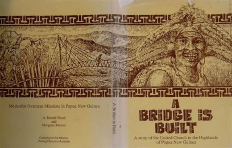
The main rivers in the Highlands are fast flowing torrents, and are the natural boundaries between clans. The first patrol of Australian Administration and Methodist Missionaries to enter the Mendi Valley in 1950 decided to pitch camps for the two contingents, one each side of the river, to establish links with the two clans. Hearing this was about to happen, the clan where they had arrived cut down the bridge to prevent their enemies receiving any benefit from these newcomers. But it wasn’t long before that group, the Unjamap people, built a new bridge, and the missionaries, from south Pacific islands and coastal regions of PNG as well as Australia, could cross and start their work.
Some of them came again 40 years later to celebrate the anniversary, by which time there was a church of over 25,000 committed Christians around the region. The hosts built a model of the bridge, but large enough for the visitors to cross as they entered the sports ground where the celebration was to be held. That bridge not only recalled the founding event; it also symbolised the new relationships established between former enemies through Christian faith and church life, and the links developed between people of different cultures and nationalities.
When good bridges are working well and the communication back and forth has become part of our lives, there’s a danger of forgetting the hard work that was done to build the bridges in the first place, whether we are talking about roads or relationships. And when the load carried by a bridge becomes too great or the structure is the worse for wear, we may realise again the value of having the bridge and how worthwhile is the effort to strengthen it for the years ahead.
May God bless our bridge building, and encourage us when we may need to give attention to creaking bridges.
Bernie
|
