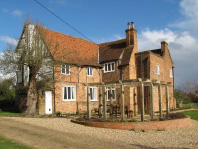
 This fascinating house, in exceptional condition, used to be the manor house of the Manor of Ickenham. It is believed to be the oldest surviving inhabited dwelling house in Middlesex. Commenced in the14th-century it was acquired by Nicholas Shorediche in 1348 and remained in the Shorediche family until about1819. (One of its members, John, was Rector of St Giles’ from 1714 until 1725). The present owner of the house, Humphrey Tizard, is a descendent of that same family.
The house was built on the site of an ancient “Motte-tower”, a fortress-like building, surrounded by a deep moat. Parts of that moat can still be seen today. Ickenham Manor Farm is a two-storeyed house with a timber frame and walls of timber, plaster and brick, plus a three-storeyed stair wing. It probably began as an open-hall house with a central, open fire with slots in the roof for the smoke to escape. This forms the rear wing and, in the 15th-century, a cross wing was added, then the stair wing and finally, in the 18th-century, two parlours. During this time, numerous small changes would have taken place both inside and out.
The result is an eclectic mixture of various styles, materials and quality of workmanship and an enormous challenge to the would-be preserver. That task, of course, falls on Humphrey’s shoulders and is made harder by virtue of the building’s Grade I listing. Practically everything he does in the way of improvement or repair requires prior permission. Yet he has responded with enthusiasm and a considerable investment in tireless energy. “It is important”, he says, “that alterations and repair to our heritage are properly controlled and supervised. The chief reason why the building has degraded is the use of inappropriate materials, especially Portland cement, mainly by the Victorians. Using traditional materials is not a problem in terms of cost – the difficulty today is finding artisans to apply them”.
Humphrey has supervised and participated in six major repair projects, the most significant being the radical repair of the tower which had been inadvisably rendered with modern cement, causing damp to be locked in with devastating results. Another satisfying improvement was the restoration of the kitchen, revealing a long-hidden brick floor which is now regularly treated with beeswax made on the premises! One of his most recent innovations is the pergola, which he built largely single-handed, on the south-west aspect to greet the arriving visitor, as are the new, planted flower beds. Ickenham Manor Farm is not only one of Ickenham’s treasures but also one of the nation’s and it is reassuring to know that it is in such excellent hands.
Alan Noad